
Virginia Tax Incentives and Credits to be Aware of When Remodeling
Updated July 20, 2026: This article has been reviewed and revised to reflect current federal and Virginia tax-credit rules as of July 20, 2026. Updates include the expiration of federal Sections 25C and 25D for improvements completed after 2025, current Virginia Historic Rehabilitation and Livable Home Tax Credit limits, and updated utility-program guidance. Programs and eligibility requirements may change, so homeowners should verify current details before making financial decisions.
If you’re remodeling your home in Virginia, certain state tax credits and utility incentives may help reduce your costs. However, the incentive landscape changed significantly in 2026. Two widely used federal home-energy credits expired at the end of 2025, making it especially important to understand which programs remain available.
Here’s the short version:
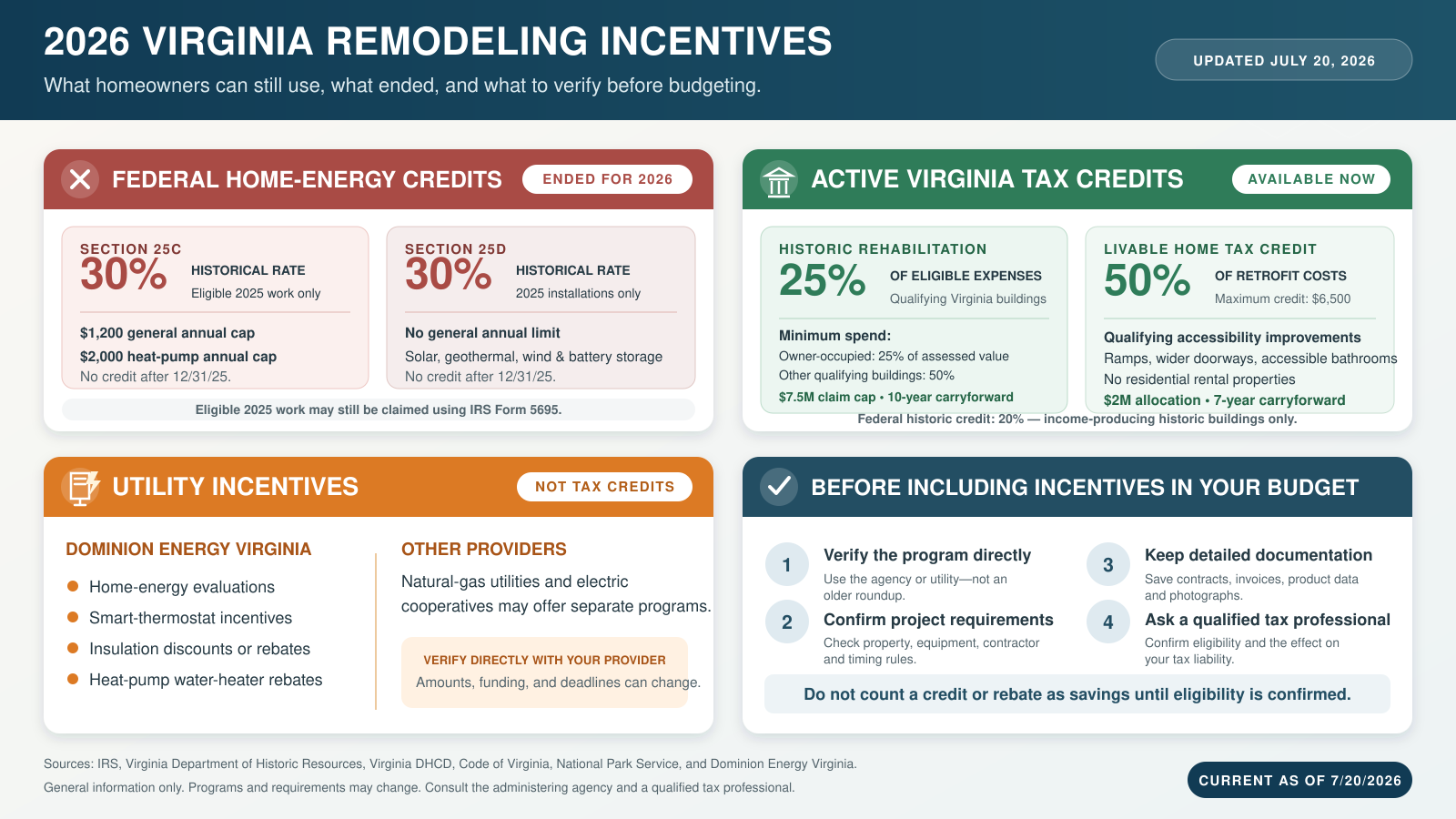
- Federal Home-Energy Credits: The Energy Efficient Home Improvement Credit and Residential Clean Energy Credit are no longer available for qualifying improvements completed after December 31, 2025. Homeowners who completed eligible work in 2025 may still claim these credits on their 2025 tax returns [1] [2].
- Virginia Historic Rehabilitation Tax Credit: Provides a state income-tax credit equal to 25% of eligible expenses for qualifying work on certified historic properties [3].
- Virginia Livable Home Tax Credit: May cover up to 50% of qualifying accessibility retrofit costs, with a maximum credit of $6,500 [4].
- Utility Rebates: Dominion Energy Virginia and other utility providers may offer rebates, discounts, and energy-assessment programs for qualifying improvements. Programs and amounts can change, so homeowners should verify current terms directly with their utility provider [5].
To pursue any available incentive, verify the requirements before construction begins and maintain detailed records throughout the project.
Disclaimer: This article is provided for general informational purposes only and is not intended as tax, legal, or financial advice. Tax laws, incentive programs, eligibility requirements, funding, and rebate amounts are subject to change. Lane Homes & Remodeling does not provide tax or legal advice and cannot guarantee approval for any tax credit or rebate. Homeowners should consult a qualified tax professional, accountant, or attorney to determine eligibility and confirm how these programs apply to their individual circumstances.
Federal Home-Energy Credits: What Changed in 2026
Two federal credits that previously helped homeowners offset the cost of energy-efficient improvements expired at the end of 2025.
Energy Efficient Home Improvement Credit
The Energy Efficient Home Improvement Credit, also known as Section 25C, previously provided a credit equal to 30% of certain qualifying expenses. The combined annual maximum was generally up to $3,200.
Qualifying improvements could include insulation, air sealing, exterior doors, windows, central air conditioners, furnaces, boilers, heat pumps, heat-pump water heaters, biomass equipment, and professional home-energy audits. The credit included a general annual limit of $1,200, plus a separate annual limit of up to $2,000 for qualifying heat pumps, heat-pump water heaters, biomass stoves, and biomass boilers.
Under current federal law, the credit is not available for qualifying property placed in service after December 31, 2025 [1].
Homeowners who completed eligible work in 2025 may still claim the credit on their 2025 federal tax returns. The credit is nonrefundable, meaning it cannot exceed the homeowner’s federal income-tax liability, and unused amounts cannot be carried forward. For specified products placed in service during 2025, taxpayers may also need to report a Qualified Manufacturer Identification Number.
Residential Clean Energy Credit
The Residential Clean Energy Credit, also known as Section 25D, previously provided a 30% credit for qualifying residential clean-energy systems. Eligible property included solar panels, solar water heaters, geothermal heat pumps, small wind turbines, fuel cells, and qualifying battery-storage systems.
Under current federal law, the credit is not available for qualifying expenditures made after December 31, 2025. For this purpose, the IRS generally treats the expenditure as occurring when the original installation is completed [2].
Homeowners who completed an eligible installation in 2025 may still claim the credit on their 2025 federal tax returns. The credit is nonrefundable, but qualifying unused credit from an eligible year may generally be carried forward to reduce future federal tax liability.
Claiming Eligible 2025 Federal Credits
Homeowners claiming either credit for qualifying work completed in 2025 should file IRS Form 5695 with their federal tax return.
Keep all relevant documentation, including:
- Contracts and invoices
- Proof of payment
- Installation records
- Manufacturer certification statements
- Qualified Manufacturer Identification Numbers when required
- Product efficiency specifications
- Separate equipment and labor cost breakdowns
- A qualifying written report for a home-energy audit
Homeowners planning projects for 2026 or later should not include Sections 25C or 25D in their anticipated savings.
Virginia Tax Incentives and Credits
Although the two primary federal home-energy credits have expired, Virginia continues to offer programs related to accessibility and historic preservation. Utility providers may also offer rebates and discounts for certain energy-efficient products and improvements.
Virginia Energy-Efficiency Incentives
For most owner-occupied remodeling projects, Virginia does not currently offer a broad statewide income-tax credit comparable to the former federal home-energy credits. Richmond homeowners may still have access to rebates, discounts, and energy-assessment programs through their utility providers.
Dominion Energy Virginia currently offers home-energy evaluations and incentives for certain qualifying products and improvements, including smart thermostats, insulation, heat-pump water heaters, and other energy-saving equipment [5].
Some qualifying customers may also have access to no-cost energy assessments and selected energy-saving improvements through Dominion’s Income and Age Qualifying Program.
Natural-gas providers may offer separate rebates for qualifying heating equipment, water heaters, smart thermostats, and related improvements. However, service areas, rebate amounts, equipment standards, contractor requirements, funding, and submission deadlines can change.
Before purchasing equipment or including a rebate in your remodeling budget, confirm the current program directly with your utility provider. Keep receipts, product specifications, contractor documentation, and proof of installation for any incentive you intend to pursue.
Program Availability Notice: Utility rebates, tax credits, and incentive programs are administered by third parties and may change, expire, or become limited by available funding. Lane Homes & Remodeling cannot guarantee program availability or approval.
Virginia Livable Home Tax Credit
The Virginia Livable Home Tax Credit helps offset the cost of improvements that make homes more accessible and functional for people with physical or sensory disabilities.
For existing homes, the program may provide a state income-tax credit equal to 50% of qualifying retrofit costs, with a maximum credit of $6,500 per residence. The program may also provide a credit of up to $6,500 for the purchase or construction of a qualifying new accessible residence [4].
Qualifying improvements may include:
- Entry ramps
- Widened doorways
- Accessible bathrooms
- Accessible routes through the home
- Specialized alarm systems
- Other modifications designed to improve accessibility or universal visitability
The credit does not apply to the purchase, construction, retrofitting, or renovation of residential rental property [6].
The program has an annual statewide allocation of $2 million. If approved applications exceed the available allocation, credits are distributed proportionally among eligible applicants. Credits that exceed an applicant’s Virginia income-tax liability may be carried forward for up to seven taxable years.
Virginia homeowners and licensed contractors may apply. Because eligibility and documentation requirements vary by project, review the current program guidelines and keep accessibility-related expenses clearly documented.
Virginia Historic Rehabilitation Tax Credit
Virginia encourages the preservation of historic properties through a state income-tax credit equal to 25% of eligible rehabilitation expenses [3].
Virginia’s program applies to both owner-occupied homes and income-producing properties. The separate Federal Historic Preservation Tax Credit remains available at 20% for qualifying income-producing historic buildings, but it does not apply to private owner-occupied residences [7].
In some cases, qualifying income-producing properties may be eligible for both the 25% Virginia credit and the 20% federal historic credit. Eligibility under one program does not automatically guarantee eligibility under the other.
Which Properties Qualify?
Under Virginia’s program, a property may qualify if it is:
- Individually listed on the Virginia Landmarks Register or National Register of Historic Places
- Certified as contributing to a listed historic district
- Formally certified as meeting the criteria for listing under the state program
A locally designated historic property or locally designated historic district does not necessarily qualify. Eligibility must be established through the Virginia Department of Historic Resources [3].
How Much Must Be Spent?
For an owner-occupied home, eligible rehabilitation expenses must equal at least 25% of the building’s assessed value for local real-estate-tax purposes in the year before rehabilitation work began.
For commercial and other qualifying buildings, eligible expenses must equal at least 50% of the building’s assessed value [8].
Which Expenses Are Eligible?
Eligible expenses may include:
- Structural repairs
- Roofing, walls, floors, ceilings, chimneys, and stairs
- Windows and doors
- Permanently installed flooring and tile
- Custom cabinetry and countertops designed for the space
- HVAC systems
- Plumbing and electrical work
- Qualifying kitchen and bathroom renovations
- Accessibility improvements
- Architectural and engineering fees
- Construction-management and preservation-consulting costs
- Certain solar and geothermal systems under the Virginia state program
Expenses that generally do not qualify include:
- Property-acquisition costs
- New additions or building enlargements
- Most excavation
- Personal property such as furniture and freestanding appliances
- Modular or mass-produced cabinetry built off-site
- Most landscaping and site improvements
- Marketing and feasibility studies
- Most financing and leasing costs
These lists are not exhaustive. Eligibility depends on the project and how each expense is treated under the program [9].
The Application Process
Virginia uses a three-part certification process:
- Evaluation of Significance: Establishes that the building is historic and eligible for the program.
- Description of Rehabilitation: Describes the property’s significant architectural features and the proposed work.
- Certification of Completed Work: Confirms that the completed rehabilitation complies with the Secretary of the Interior’s Standards for Rehabilitation.
Pre-rehabilitation photographs are required to document the property’s original condition. Completed-project photographs must also accompany the final application. Because the entire project must comply with the applicable preservation standards, homeowners should coordinate with the Virginia Department of Historic Resources before work begins.
All completed projects require review by an independent Certified Public Accountant. Projects with total expenses under $500,000 require an Agreed-Upon Procedures report. Projects totaling $500,000 or more require an independent audit [10].
Unused Virginia Historic Rehabilitation Tax Credits may be carried forward for up to 10 taxable years. For taxable years beginning on or after January 1, 2025, each taxpayer may claim no more than $7.5 million in Historic Rehabilitation Tax Credits during a single taxable year, including credits carried forward from prior years [8].
Historic Property Disclaimer: Historic tax credits require strict compliance with preservation standards and documentation requirements. Changes made outside the approved scope may affect eligibility. Lane Homes & Remodeling can assist with project planning and documentation but cannot guarantee approval of any tax credit.
How to Use Tax Incentives in Your Remodeling Plan
Timing Your Remodeling Activities for Maximum Benefit
Timing remains important, but the incentives available to homeowners changed significantly in 2026. The federal Energy Efficient Home Improvement Credit and Residential Clean Energy Credit are no longer available for qualifying improvements completed after December 31, 2025. Homeowners who completed eligible work in 2025 may still claim these credits on their 2025 tax returns, but homeowners planning projects for 2026 or later should not include them in their anticipated savings [1] [2].
For historic properties, careful scheduling is especially important. Virginia’s Historic Rehabilitation Tax Credit generally requires homeowners to satisfy the material rehabilitation test within a consecutive 24-month measuring period. Projects completed under an approved phasing plan may use a 60-month measuring period [3].
This does not necessarily mean the entire project must be completed within 24 or 60 months. Instead, the measuring period determines whether enough qualifying expenses were incurred to meet the program’s spending requirements.
Utility rebates and discounts may also have purchase, installation, or application deadlines. Before purchasing equipment or beginning installation, confirm the current terms directly with your utility provider.
Planning for Energy Efficiency, Accessibility, and Preservation
A professional home-energy assessment can still be a valuable starting point, even though the former federal credit of up to $150 is no longer available for audits completed after 2025 [1].
An assessment can identify air leaks, insufficient insulation, inefficient ductwork, and aging HVAC equipment. This can help homeowners prioritize the improvements most likely to increase comfort and reduce long-term energy costs. Some utility providers also offer free or subsidized assessments.
If accessibility improvements are part of the remodel, review the Virginia Livable Home Tax Credit requirements before finalizing the project scope. Keep accessibility-related contracts, invoices, product information, and proof of payment separate and clearly documented.
For historic homes, coordinate with the Virginia Department of Historic Resources before work begins. Eligible expenses may include structural work, HVAC, plumbing, electrical systems, custom cabinetry, and other permanently installed improvements.
Virginia’s state historic credit may also cover qualifying geothermal systems and permanently integrated solar installations. Under the state program, solar equipment must generally be integrated into the electrical system and cannot be subject to another Virginia tax benefit [9].
Because eligibility depends on the property, project scope, and preservation standards, homeowners should obtain guidance before assuming a particular expense will qualify.
How Lane Homes & Remodeling Can Help
Managing design requirements, incentive programs, and project documentation can feel complicated. Lane Homes & Remodeling’s integrated design-build approach helps coordinate the design, planning, and construction process under one roof.
For historic projects, our in-house architectural drafting team can help develop plans that account for the Secretary of the Interior’s Standards for Rehabilitation while incorporating modern energy-efficiency, accessibility, and comfort goals.
We can also help homeowners organize project information and construction documentation. Final eligibility and approval for any tax credit or rebate remain with the administering agency or utility provider. Homeowners should consult a qualified tax professional to determine how a particular credit applies to their circumstances.
Conclusion: Making the Most of Available Incentives
Virginia homeowners may still find meaningful savings through state tax credits and utility programs, but the available incentives have changed.
The federal Energy Efficient Home Improvement Credit and Residential Clean Energy Credit ended for qualifying improvements completed after December 31, 2025. For projects beginning in 2026, the most relevant opportunities may include Virginia’s 25% Historic Rehabilitation Tax Credit, the Virginia Livable Home Tax Credit, and current rebates or discounts offered by utility providers.
The key is to verify eligibility before work begins and maintain thorough documentation throughout the project. Historic-property owners should coordinate with the Virginia Department of Historic Resources and follow the approved scope of work. Homeowners pursuing accessibility credits should keep qualifying expenses clearly separated and review the current DHCD requirements.
By planning early, confirming current requirements, and consulting the appropriate professionals, homeowners can pursue available incentives without building outdated or uncertain savings into their remodeling budgets.
Frequently Asked Questions
Are Federal Home-Energy Tax Credits Available for Projects Completed in 2026?
The Energy Efficient Home Improvement Credit under Section 25C and the Residential Clean Energy Credit under Section 25D are not available for qualifying improvements completed after December 31, 2025 [1] [2].
The separate 20% Federal Historic Preservation Tax Credit remains available for qualifying income-producing historic buildings. It does not apply to private owner-occupied homes [7].
What Home Upgrades Are Eligible for the Virginia Livable Home Tax Credit?
The Virginia Livable Home Tax Credit may apply to qualifying accessibility or sensory modifications. These can include structural changes and certain permanently installed features designed to assist people with physical or sensory disabilities.
Common examples include wheelchair ramps, widened doorways, accessible bathrooms, accessible routes, and specialized alarm systems. The credit may equal up to 50% of eligible retrofit costs, with a maximum benefit of $6,500 per residence [4].
The credit does not apply to residential rental property.
What’s the Best Way to Time My Remodeling Project to Take Advantage of Tax Credits?
Identify potentially applicable programs before the design and construction scope is finalized.
Virginia’s Historic Rehabilitation Tax Credit generally requires the material rehabilitation test to be satisfied within a consecutive 24-month measuring period. An approved phased project may use a 60-month measuring period [3].
Utility rebates may have separate purchase, installation, and application deadlines. Confirm those requirements directly with the utility provider before ordering equipment or beginning installation.
Homeowners planning projects for 2026 or later should not spread work across multiple years in anticipation of receiving the expired federal Sections 25C or 25D credits.
What Documents Do I Need to Claim Federal and Virginia Tax Credits?
Homeowners claiming an eligible federal home-energy credit for work completed in 2025 should file IRS Form 5695 and retain receipts, manufacturer information, Qualified Manufacturer Identification Numbers when required, installation records, and detailed equipment and labor cost breakdowns.
Virginia’s Historic Rehabilitation Tax Credit uses a three-part certification process administered by the Virginia Department of Historic Resources. Applicants may need to provide application forms, contracts, invoices, detailed expense schedules, architectural documents, and photographs showing the property before and after rehabilitation.
All completed state historic-credit projects require financial review by an independent CPA. Projects with total expenses under $500,000 require an Agreed-Upon Procedures report, while projects totaling $500,000 or more require an independent audit [10].
Applicants for the Virginia Livable Home Tax Credit should retain invoices, proof of payment, project descriptions, and documentation showing how the completed improvements satisfy the program’s accessibility requirements [4].